
Between September 2025 and August 2026, Resident Advisor listed 68,930 club nights that pulled at least 20 people, across 400 destinations, on all 365 days. Noovo crawled every one of them to answer the question a leaderboard never answers: not which city throws the most parties, but which month is the right month to be in which city. The answer is a calendar. Amsterdam in October. Detroit in May. Barcelona in June. And two months of the year where nothing, anywhere, clears the bar.
Turns out the biggest week in Detroit's year is not the festival. Of the 219 club nights the city listed in May, only 26 of them are Movement.
The top four never move, which is exactly what makes the ranking useless
London, Berlin, New York and Barcelona hold first through fourth place in this dataset at every threshold tested, in all twelve months, without a single swap. That is a robust finding and a worthless recommendation, because nobody picks a weekend based on which city has the most club nights in aggregate. People ask where to go in March, whether the room will hold three hundred people or thirty, and whether the door will let them in.
The only break in that podium all year is June 2026, when Barcelona finished first in the world.
Some scale first. Of the 68,930 nights over 20 RSVPs, 28,060 cleared 100 and 5,320 cleared 500. The loudest month on earth was May 2026 with 7,141 club nights. The quietest was January 2026 with 4,463, a drop of 37 percent. One honest note before any of it means anything: RSVPs are not door numbers. The attending count is people marking themselves as going on Resident Advisor, which is a fair proxy for scale and is not a ticket scan. Everything below rests on that, and says so.
A city is worth flying to when it beats itself, not when it beats London
Counting events at one cutoff makes a spike easy to fake. A promoter dumping fifty listings inflates the 20-plus count without one extra person dancing. One festival landing inflates the 500-plus count while the city's ordinary weekends stay exactly as they were. Neither is a scene doing anything.
So the test here is concordance. A city-month only counts as a surge when it lifts at all three cutoffs at once, measured against that city's own median for the other eleven months. More nights, bigger nights and headline nights, together. The score is the weakest of the three lifts, so a month is only as strong as its softest link. Because every city is compared to itself, a city being popular on Resident Advisor cannot buy it a place on this list.
Three months that a naive count would have called a boom, and this test throws out:
- Paris, October 2025. Listings rose 50 percent over its own baseline while nights over 500 RSVPs fell to 57 percent of normal. More stuff on the calendar, smaller rooms.
- Glasgow, December 2025. Nights over 500 RSVPs jumped 2.6 times on an otherwise flat calendar. One big show is not a scene.
- Miami, March 2026. The city goes from 13 club nights to 57, four times its normal, and records zero nights over 500 RSVPs in the entire month.
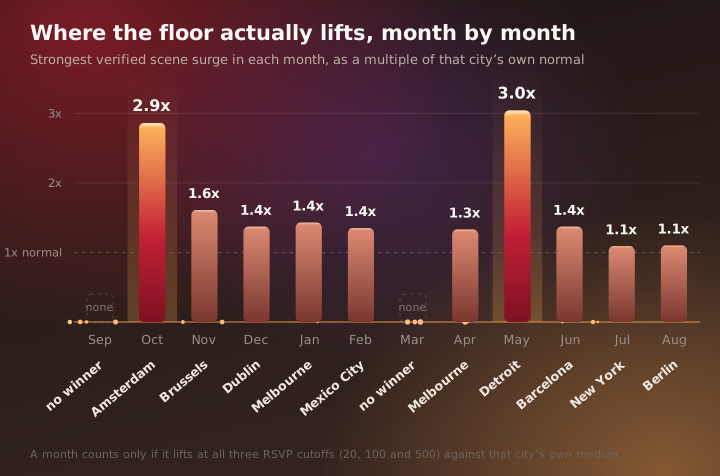
The calendar
September: Ibiza, on the way out
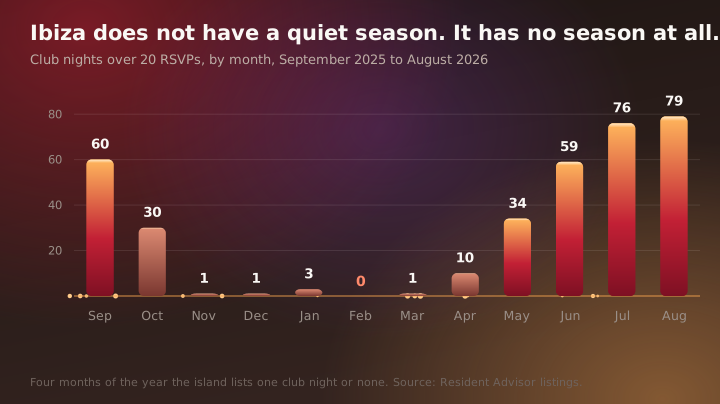
No city passes the surge test in September, so take the honest answer instead. Ibiza lists 60 club nights over 20 RSVPs in September, its third biggest month of the year, and then it closes. Closing season runs through the first weeks of October and the island is effectively dark by November.
October: Amsterdam, and it is not close
The single strongest month any city has all year outside Detroit. Amsterdam lifts 2.9 times at 20 RSVPs, 3.4 times at 100 and 10 times at 500. It lists 517 club nights, which is 21 percent of the city's entire year in one month, and 40 of its 89 nights over 500 RSVPs land inside it. That is Amsterdam Dance Event, and the shape of it matters: Amsterdam ranks 5th in the world at the 100-plus bar and only 9th at 500-plus, which tells you this is hundreds of mid-size rooms rather than a handful of arenas. You are not queuing for one giant thing, you are choosing between forty good ones a night.
October is also the best month on earth to be almost anywhere. Dublin, Brussels, Manchester, Milan, Glasgow, Los Angeles and Mexico City all surge in the same four weeks.
November: Brussels
Brussels lifts 1.6 times at 20, 3.1 times at 100 and 4 times at 500. Listen Festival spreads across Kanal, C12, Fuse and Les Halles rather than one site, and a distributed city festival is the textbook version of a real surge. The whole city is full on the same nights instead of one field outside it.
December: Dublin
Dublin lifts 1.4 times with its big nights up 1.75 times, on a calendar that holds steady all year. December is also when Glasgow's numbers look better than the city actually is, so read that one carefully.
January: Melbourne
Melbourne lifts 1.43 times at 20, 1.71 at 100 and 1.67 at 500. January is the global trough, 4,463 club nights against May's 7,141, which is precisely why the southern hemisphere is the answer. If you want the northern winter version of this, the shoulder-season logic applies to dancefloors as neatly as it does to beaches.
February: Mexico City
Mexico City lifts 1.35 times at 20 and doubles its nights over 500 RSVPs. It is the only city in the world that passes the test in February. For contrast, Ibiza lists exactly zero club nights over 20 RSVPs that month.
March: nobody
No city anywhere clears the test in March. Miami comes closest and fails on the third cutoff, and the reason is instructive rather than damning: a third of Miami's listings sit on Shotgun instead, so the platform loses sight of the crowd rather than the crowd failing to show up. March is the month to spend on the four cities that are always good, or to go somewhere for a reason that has nothing to do with a lineup.
April: Melbourne again, and Amsterdam quietly
Melbourne lifts 1.33 times, Amsterdam 1.28 and Milan 1.20. April is Amsterdam's second act, at a tenth of October's intensity and a fraction of October's prices.
May: Detroit, the biggest surge of the year
Detroit lifts 3.0 times at 20 RSVPs, 4.0 at 100 and 5.1 at 500. It lists 219 club nights, 21.8 percent of its entire year, and 46 of its 148 nights over 500 RSVPs. The city ranks 15th in the world at the 100-plus bar and climbs to 6th at 500-plus, which is what a genuine headline weekend looks like in data.
Here is the part worth acting on. Only 26 of those 219 nights are Movement itself. The lift is the unofficial ecosystem around it, the afters and the label showcases and the parties that have run in parallel for twenty years. Book the week, not the festival.
May is also the loudest month on the planet, 7,141 club nights, with twelve cities surging at once including London, Berlin, Barcelona, Amsterdam, Madrid, New York, Dublin, Copenhagen and Toronto.
June: Barcelona takes first place in the world
Barcelona lifts 1.4 times at 20, 1.6 at 100 and 2.8 at 500, and posts 101 nights over 500 RSVPs against Berlin's 89 and London's 89. That is the only time in twelve months that anyone knocks London off the top.
The driver is not the festival most people book. The six biggest events of Barcelona's June are all Off Week showcases, the club programme that runs alongside Sónar rather than inside it. You can go to Barcelona that week, never buy a festival ticket, and still be in the best-attended rooms in the world.
July: New York, and Ibiza at full volume
A thin month for surges. New York lifts 1.09 times, which is real but modest. Ibiza is at 76 club nights and climbing, which is the honest reason July exists on this calendar.
August: Berlin and London
Berlin lifts 1.10 times at 20 and 1.72 at 500. London posts 862 club nights and 169 over 500 RSVPs, its single biggest month at that bar all year. Ibiza peaks at 79. August is not a discovery, it is just correct.
How to behave in a room you have never been in
Most of what separates these scenes is not the music. It is the rules, and the rules are usually older and more serious than they look from outside.
The sticker on your camera is not a gimmick. At Berghain in Berlin and at Bassiani in Tbilisi, staff cover phone cameras on the way in and you leave if you peel it off. Berghain's is about protecting a space built for a queer crowd that wants to dance without being filmed. Bassiani's is about a club that was raided by armed police in 2018, an event that put thousands of people outside the Georgian parliament. Manchester's Warehouse Project went phone-free in 2025 for the plainer reason that everyone was watching the show through a screen. Treat the sticker as the price of entry.
The clock is a local law, not a preference. Berlin's clubs have no obligation to close, which is why Saturday night is Sunday afternoon, and why Berlin techno culture entered Germany's national inventory of intangible cultural heritage in March 2024. Amsterdam grants a small number of 24-hour licences, deliberately to venues outside the busy centre so the whole city does not hit the street at once. In Japan, dancing after midnight was effectively illegal until the entertainment businesses law was amended in 2015. Arriving at midnight is early in one city and closing time in another.
A door policy is a curation decision. Selective doors in Berlin get read as arbitrary from the outside. The consistent thread in how these clubs describe themselves is protecting the crowd already inside, which is the same logic as the camera stickers. Go in twos and threes rather than tens, know who is playing, and do not treat the queue as a negotiation.
Underground and expensive are different axes. Ibiza clears 100 RSVPs on only 6 percent of its listed events, and not because its parties are small. Its clubs sell through their own channels. A low number on a listings site can mean a small scene, a closed scene, or a scene that sells its tickets somewhere else.
What this data cannot see
Resident Advisor is a listings platform with a footprint, not a census of world nightlife. Three blind spots matter enough to name before anyone quotes a rank.
Platform share, which is measured here rather than assumed. A sample of 22 cities against Shotgun found that in Paris and Lyon, Shotgun carries the overwhelming majority of listed events, 87 percent and 91 percent, so Resident Advisor sees a minority of what is happening in France. In Berlin, London, Glasgow and Detroit, Shotgun is effectively absent and the picture is close to complete. The correction is real, it is large, and it is confined to specific countries.
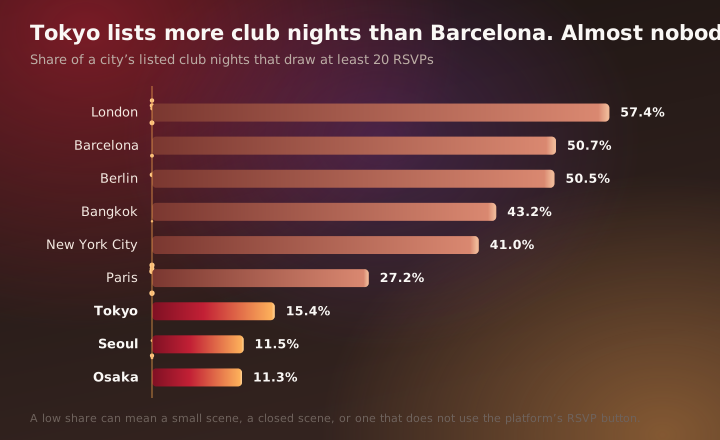
Tokyo, which is not a coverage problem. This one surprised us. Resident Advisor lists 11,872 Tokyo events a year, the fourth most-listed city on the platform, ahead of Barcelona. Only 15.4 percent of them draw 20 RSVPs, against 57.4 percent in London. Japan's own portal clubberia, which has shared event data with iFLYER since 2018, lists just 1,855 Tokyo events over the same year, 6.4 times fewer than Resident Advisor, so a missing platform does not explain it either. Tokyo's absence from these rankings is behavioural. The city lists its nights and does not RSVP to them.
Genre and geography. This is electronic music only, and the platform is thin across Africa, South Asia and much of Latin America. Whole regions run their nights through listings and ticketing platforms that are not in this dataset at all: Ticketmelon and Eventpop in Thailand, Loket in Indonesia, clubberia and iFLYER in Japan. A city missing from this calendar is sometimes a quiet city and sometimes a city nobody is listing on the platform we counted. Do not read absence as evidence.
One more thing to be straight about. This is the year behind us, not a forecast. It works as next year's calendar because the things driving it are annual fixtures that have run for years, and it will stop working the moment one of them moves. A quarter of UK towns have lost every nightclub they had, so the assumption that the room will still be there is not a safe one.
The hard part was never the where. It is the who
You now have twelve months and a defensible answer for ten of them. The reason most of these trips still do not happen is that October in Amsterdam is not a destination problem. It is four people, four calendars, and a group chat where somebody says "we should do ADE this year" in February and nobody says anything else until November.
That is the gap Noovo is built to close. You start with whichever piece you have, a person you want to be there with, a city you keep reading about, or a week that just opened up, and you see who else is free in that window and where your people are already going. A weekend in Detroit in May stops being a message nobody answers and becomes a set of dates that three of you already share. If you want the mechanics, start with how to find out which friends are free to travel and how to plan a group trip without losing the group chat. For the flights, the booking window that actually works matters more in October and May than in any other month on this list.
There is a second half coming. Noovo is adding interests to your profile, and Parties is one of them, alongside live music and everything else people actually organise their year around. Events follow from that. The rule we have already set for ourselves is that an event only ever surfaces when it is relevant to something you have actually declared, a home city, a trip you are taking, or a free week you have marked. Never a feed of things to do. If you are going to be in Barcelona the second week of June, that is when the Off Week programme is worth telling you about, and not before.
Find the overlap. Pick the month. Go.
The numbers, if you want them
Everything above is checkable. The full research appendix, with the method, the monthly ladder at all three cutoffs, threshold sensitivity, RSVP survival rates by city, the platform coverage sample and the complete leaderboard, is published as a standalone page: The Dancefloor Index.
The aggregates behind each claim are downloadable, so you do not have to take the charts on trust:
- City by month matrix (CSV). Every destination's club-night count at the 20-plus cutoff, for each of the twelve months.
- Scene surges (JSON). Every city-month that passes the concordance test, with its lift at all three cutoffs, its raw counts and its share of the city's year.
- Platform coverage sample (JSON). Shotgun against Resident Advisor across 22 cities, the basis for the France correction.
- RSVP survival rates (JSON). For nine major scenes, the share of listings clearing 20 and 100 RSVPs.
- Tokyo against clubberia (JSON). Month-by-month counts on both platforms, the basis for the claim that Tokyo's absence is behavioural.
These are aggregates rather than the underlying event-level dump, which is Resident Advisor's data to publish, not ours.
Sources
- Shotgun and clubberia, the platforms used to measure what Resident Advisor does not see
- The Dancefloor Index, the full research appendix and method
- Resident Advisor listings, 68,930 events over 20 RSVPs, 400 destinations, September 2025 to August 2026, crawled 8 September 2026
- Rave the Planet on techno culture in Berlin entering the German national inventory of intangible cultural heritage, 13 March 2024
- City of Amsterdam, night vision and 24-hour licences
- The Washington Post on Japan's dancing restrictions and the 2015 amendment
- Dazed on the 2018 police raid on Bassiani and the protests that followed
- Time Out on Warehouse Project's no-phones policy, 2025
- The Night Time Industries Association on UK nightclub closures
- Metro Times on Detroit techno
- iFLYER and clubberia, Japan's own listings ecosystem