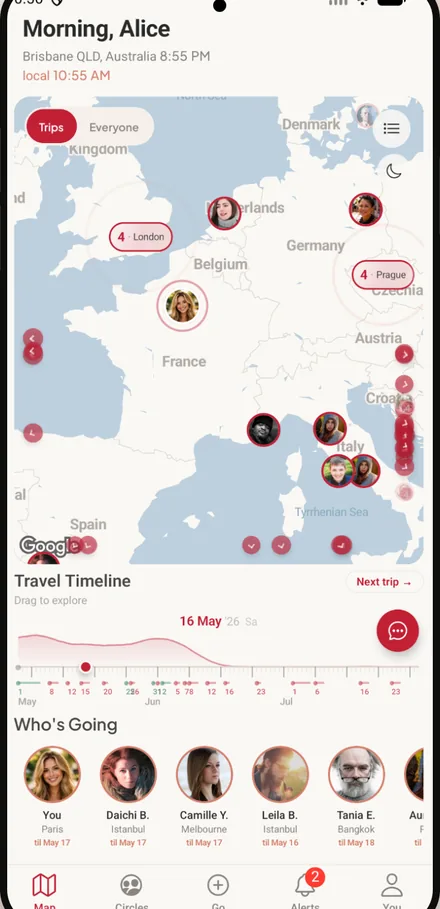

Turns out the most famous restaurant rating in the world is a travel rating. The Michelin Guide didn't start as a food guide. It started as a free booklet from a tyre company that wanted people to drive further. Three Michelin stars still carries that original meaning: a restaurant worth a special trip of its own. That makes a three-star table one of the few reservations that plans the trip for you. Noovo, the social trip-planning app built around who you travel with, where you are headed, and when you are free, is a good fit for exactly this, because a single booking quietly decides all three.
This is the practical guide: what the stars actually measure, where they cluster in 2026, and how to plan a trip, and a group, around one table.
The Michelin Guide was built to make you travel
In 1900 the Michelin brothers, André and Édouard, gave away roughly 35,000 copies of a small red guide to French drivers. It listed mechanics, petrol, maps, and places to eat and sleep. The logic was simple. More driving meant more worn tyres, and more worn tyres meant more Michelin sales.
The star came in 1926. The three-tier system followed in the early 1930s, and in 1936 Michelin published the definitions that are still used today. Every one of them is about distance:
- One star: high-quality cooking, worth a stop.
- Two stars: excellent cooking, worth a detour.
- Three stars: exceptional cuisine, worth a special journey.
Read those again as a driver in 1936 would have. They are not a scoreboard. They are a routing instruction. One star means pull over if you're passing. Three stars means plan the trip around it.
The stars rate the plate, not the room
Michelin's anonymous inspectors pay for their own meals and judge every restaurant against the same five criteria, in any country: the quality of the ingredients, mastery of flavour and cooking technique, harmony of flavours, the personality of the chef as expressed in the cooking, and consistency across the whole menu and over time. The guide is explicit that service, decor, and tablecloths are not part of the star.
That matters for planning. A one-star noodle counter and a one-star palace dining room are rated on the same thing, the food. If a group mixes budgets, the star tells you nothing about the price. The menu does.
Michelin also runs three other distinctions worth knowing before you travel:
- Bib Gourmand. Introduced in 1997 and named after Bibendum, the Michelin Man, it marks very good cooking at a moderate price. The price ceiling moves with local cost of living. France alone has 430 Bib Gourmand restaurants in the 2026 selection.
- Green Star. Awarded for sustainable practice, alongside or independent of stars.
- Michelin Keys. The hotel version, launched in 2024. The 2026 Key selection covers 2,832 hotels, and only 155 of them hold three Keys.
Three stars is far rarer than most people assume
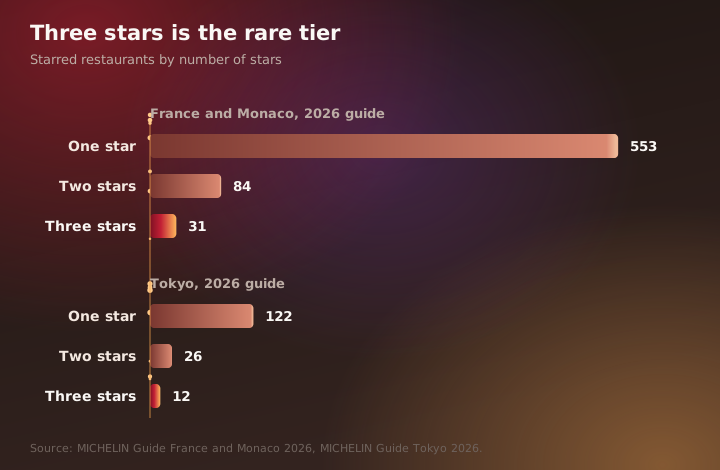
France, the guide's home country, has 668 starred restaurants in the 2026 France and Monaco selection. Only 31 hold three stars, and just one of those, Les Morainières in the Savoie, is new this year. Tokyo, the city with the most starred restaurants in the world, has 160, and 12 of them hold three stars. The next Japan selection is due in February 2027, so these are the current numbers until then.
The number to remember is roughly one in twenty. Most starred restaurants are one-star rooms, and many of them book in days, not months. The three-star rooms are the ones that set your calendar.
Tokyo has the most stars. France has the most places worth the trip
The two big Michelin destinations work very differently on the ground.
Tokyo is density. 160 starred restaurants in one city, many of them eight to ten seat counters serving sushi, tempura, or kaiseki. You can stack a one-star lunch and a two-star dinner in the same neighbourhood. The catch is access. Many top counters book through Japanese platforms, hotel concierges, or card concierge services rather than an English website, and some do not take direct bookings from overseas at all. Kyoto and Osaka add more three-star kaiseki rooms a short Shinkansen ride away. If Japan is already on the list, our guide to slow travel in Japan covers pacing a trip there.
France is spread. Paris holds a large share of the stars, but many of the 31 three-star rooms sit in villages, valleys, and wine country, exactly where the 1900 guide wanted drivers to go. A three-star in the Alps or Burgundy usually means a car, a night nearby, and a slower day. It is the original Michelin trip, almost unchanged.
The rest of the map is worth a look too. Michelin now publishes guides across Europe, Asia, North America, and the Gulf, and the newer guides tend to be one-star heavy, which means easier tables at friendlier prices.
The reservation decides your dates, not the other way round
At most restaurants you pick the night, then book. At a three-star restaurant it often runs backwards.
Many of the hardest tables release on a rolling window, commonly 30, 60, or 90 days ahead, at a fixed hour in the restaurant's own time zone. The French Laundry in California, for example, releases tables 60 days out. Some take prepaid tickets, so the money leaves your account the moment you book. Cancellation terms are usually 24 to 72 hours, with a per-person fee, and groups often pay a deposit.
So the working order for a Michelin trip is:
- Pick the restaurant, then find its release window. Check the restaurant's own booking page, not a third-party list, because windows change.
- Count back from the release date. The night you can actually get is the anchor. Everything else, flights, hotel, the rest of the itinerary, gets built around it.
- Book flexible travel first, fixed travel second. Hold a refundable room before the table drops, then book flights once the table is confirmed. Our guide to how far in advance to book flights has the timing.
- Have a backup night and a backup room. Waitlists and late cancellations are real, and a second option stops one sold-out night from cancelling the whole trip.
The table decides who comes
Here's what almost nobody plans for: the hardest part of a Michelin trip is often not the booking. It's the headcount.
Tasting-menu rooms are small. Online booking at many starred restaurants caps at four or six guests, Tokyo counters seat eight people in total, and anything larger usually means a private room, a set menu, and a deposit. A group of seven that wants one big three-star dinner is trying to book something most of these rooms simply don't sell.
The groups that pull it off split the trip instead of forcing it:
- The starred table goes to the people who care most. Two or four people who would plan a whole trip around one dinner. Everyone else books lunch at a one-star or skips it without guilt.
- The whole group gets a Bib Gourmand night. Easier to book, built for longer tables, and usually the dinner people talk about afterwards anyway.
- Agree the budget before the release date. A three-star tasting menu with drinks can run several hundred euros a head. Finding out who's in at that price is much easier a month before booking than the night the table drops.
For the wider mechanics of moving a group from idea to booked trip, see how to plan a group trip with friends.
Start with the table, then find your people
A Michelin trip is a pure case of starting with where. You know the place. You've probably known it for years. What's missing is the when, which the booking window answers for you, and the who, which the table size quietly limits.
That's the gap Noovo is built for. Put the destination on Noovo, mark the dates the release window points to, and see which friends are already free that week or already heading nearby. Someone in Lyon the same weekend as your Alps booking is exactly the kind of overlap that turns a dinner into a trip. Our piece on starting a trip from a destination walks through the rest.
The guide was printed to get people on the road in 1900. It still does the same job. Pick the table, find the night, bring the right people. See you there.