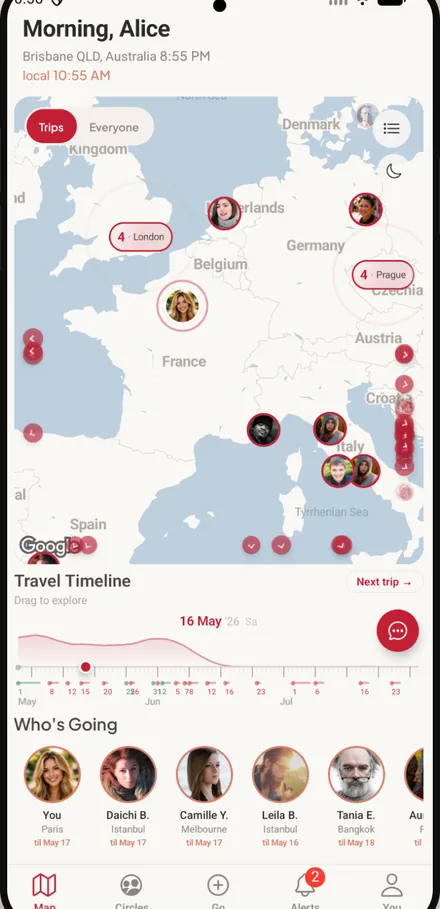

Shoulder season is the stretch between peak and off-peak: roughly mid-September to mid-November, and again March to mid-May. Per HomeToGo's 2025 shoulder season report, search interest for fall travel grew 27% year over year, and spring grew 25%. Both numbers outpaced summer for the first time. The trend isn't subtle anymore. Noovo's Start with When pillar was designed around this exact behaviour: claim the week, then build the trip.
Shoulder season works because it inverts the peak-season trade-off. The weather is still warm in most of southern Europe. The crowds have gone home. The hotel that costs €380 in August is €180 in October. The friends who said "I can't get the time off in August" can suddenly get the time off in September.
The numbers behind the shift
Per Airbnb's 2025 fall travel trends report, Gen Z bookings for fall shoulder-season trips grew 26% year over year, faster than any other demographic. The HomeToGo data is even more striking on the group dimension: average autumn trip headcount rose 9% to ~4 people per booking, and spring groups grew 19% to roughly 6 people. Shoulder-season is, quietly, a group-travel trend.
Per a 2025 Roam Report travel-advisor survey, 76% of advisors said clients are actively requesting shoulder-season alternatives to peak. The advisor channel is usually a lagging indicator, which means the behavioural shift has fully landed in the market.
Why groups thrive in shoulder season
This is the part nobody talks about. Group trips struggle in August because everyone's family is doing something else. Kids' summer camp ends, weddings cluster, parents-in-law visit. By September, those overlapping commitments clear. The week that was impossible to coordinate in August becomes trivially possible in late September.
The other piece: shoulder-season weather is forgiving in a way that benefits groups specifically. A rainy afternoon in October doesn't ruin a beach trip the way it does in July, because nobody planned the trip around the beach. A group with no fixed plan thrives when the destination has multiple modes (museums, food, walks, day trips) and shoulder season turns every destination into a multi-mode trip.
The catch: you have to claim the week
The shoulder-season advantage is real, but it has one prerequisite. Somebody has to claim the week first. Most people wait until they have a fully-formed plan before requesting time off. By the time the plan is fully formed, it's August, the destination is crowded, the prices are peak, and the friends who would have come are unavailable.
The fix is structural. Mark the week first. Build the trip around the week. This is what Noovo's free-time windows are for. You don't need to know where you're going. You need the dates locked, the friends notified, and the overlap visible. The week of October 12th is more useful as a Noovo signal than as an unspoken intention.
The shoulder-season picks worth knowing
- Greek islands in late September. The water is still 24°C. The crowds are gone. Flights from northern Europe are 40% cheaper than peak.
- Japan in early November. Autumn foliage in Kyoto, perfect weather across Honshu, the Olympic-era price inflation has unwound.
- Spain's interior in May. Madrid and Seville in their best month. Hot but not unbearable. The festival calendar is dense.
- Croatia in mid-September. Adriatic still warm, Dubrovnik no longer mobbed, ferry schedules still on summer cadence.
- Mexico City in October. Dry season starts, Day of the Dead approaches, hotels still pre-Christmas pricing.
One sentence for the group chat
Try: "I'm taking the week of October 14th off. Anywhere warm, anyone in?" That sentence does more work than three weeks of "we should plan something." Shoulder season exists because somebody made it real on a calendar first.