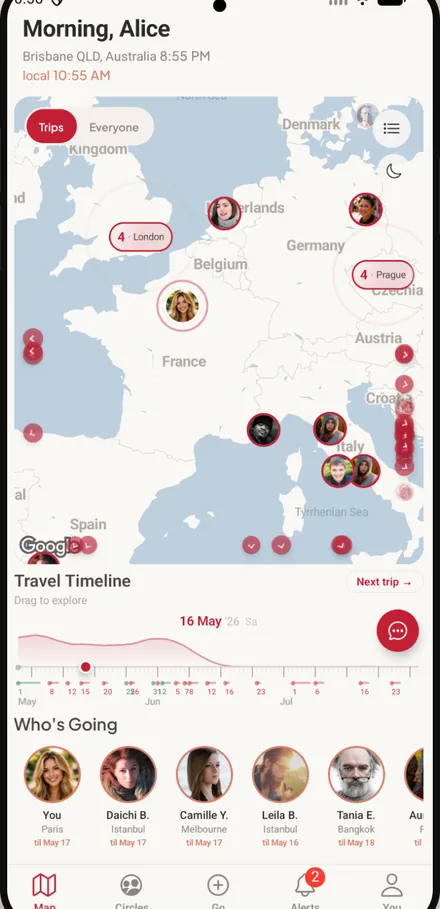

Most group trips die in the group chat. Not for lack of interest. Once the idea is out there, nobody owns the next move, and the calendar overlap quietly never gets found. I built Noovo, the social trip-planning app for friends, to fix exactly that step.
Group trip planning is mostly a coordination problem with a thin layer of taste on top. You don't need a Pinterest board. You need a shared answer to three questions: who's in, where are we going, and when can everyone go. That's what I want Noovo to give you in the first thirty seconds.
Step 1: Start with the pillar you actually have
The group-trip planning advice you've read assumes you start with a destination and "pick dates that work for everyone." That's almost never how real trips begin. They begin with one of three things:
- A person. "I want to go somewhere with Sam before they move."
- A place. "I've always wanted to go to Lisbon. Who else is in?"
- A window. "I just took the week of September 15th off. Anyone else?"
Pick the one you have. Don't fake the other two. The whole reason groups stall is that everyone tries to triangulate destination, dates, and people simultaneously. You can't. Start with one. The other two will follow.
Step 2: Find the actual overlap, not the imagined one
"Just send a Doodle poll" is the advice everyone gives. It's also the place most group trips go to die. Doodle assumes everyone already agreed on the trip and is just picking dates. Most groups never get that far.
A better move: surface the dates everyone is already free, before debating destinations. Once two or three people see they have the same week open, the trip stops being hypothetical. There's now a clock.
This is what Noovo's free-time windows do automatically. You mark a week as open. So do your friends. Noovo finds the overlap and shows it on a shared map. No poll. No thread. No "let me check with my partner." Just: three of your friends are also free the week of October 12th. Want to make it a trip?
Step 3: Lock the date before you lock the destination
Counter-intuitive but true: groups commit to a date faster than they commit to a place. Date constraints are real. You have or don't have the time off. Destination constraints are soft. Everywhere is interesting if your friends are there.
Once the date is locked, the destination conversation takes about ten minutes. Once the destination is locked first, the date conversation can take six weeks and still end in nothing.
Step 4: Give the trip an owner
Every group trip needs one person who feels enough ownership to send the "OK, who's booking flights" message. On most chats, this person never emerges. The bystander effect is real, even with four close friends and an open week.
Noovo helps by making the act of starting a trip a single tap. The person who creates the trip on Noovo is the implicit owner. The invite goes out, the dates are locked, the destination is visible, and the group is named. The "OK, who's booking flights" message becomes a button.
Step 5: Tag the friend who needs to be tagged
There is one friend in every group who says "I'm down for anything" and then vetoes every actual proposal. The way to plan around them isn't to argue. It's to tag them before the question is "are you in." When the question is still "can you make this week."
Noovo's accountability invite reframes the question. Instead of a passive "you've been invited to a trip" notification, it surfaces as: Alice is going to Lisbon in October and tagged you. Are you in? The friend who used to "need to check" now has to give a real answer to a real friend.
What good group trip coordination looks like
You don't need a project manager. You need three things:
- One person who owns the trip the moment it's named.
- A shared view of when everyone is actually free.
- A way to invite that demands a real response instead of disappearing into a thread.
Noovo bundles all three. The trip gets an owner the moment it's created. The free-time overlap is already visible on the map. The invite asks a question your friends have to answer.
See you in Lisbon.