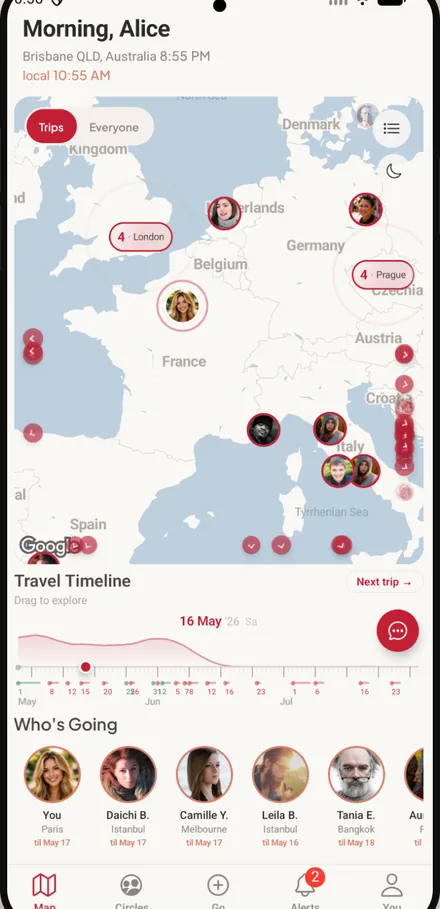

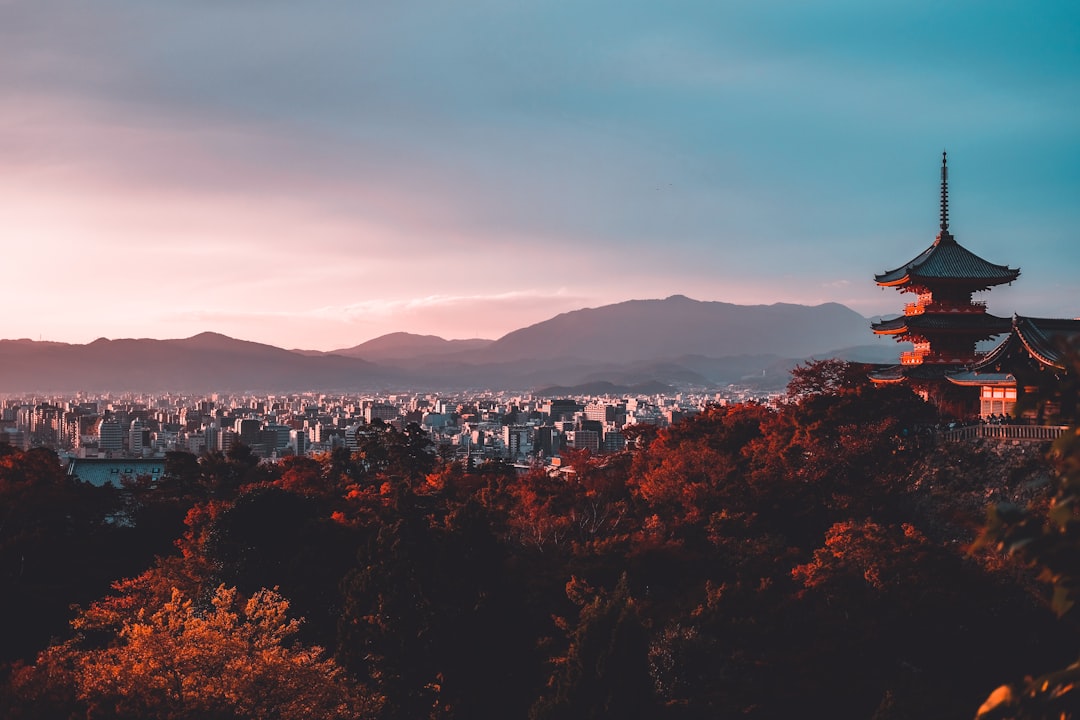
A friend of mine has been in Japan for a few weeks, traveling with his wife and their three kids, the youngest just five. I texted him to say hi and ended up a little jealous. He's working three hours every morning, doing schoolwork and sightseeing with the family through the afternoon, then grafting again at night. When I told him I had aspirations to do a trip like his one day, he wrote back two words: "perfect time." Noovo, the social trip-planning app for friends, exists for the exact pull behind that text. A friend already somewhere good, and a trip you keep meaning to take.
Slow travel to Japan with kids is the version of that trip a lot of families are quietly pulling off in 2026, and the numbers behind the surge aren't subtle. The case for going slow, and for going now, is stronger than it's ever been.
Why Japan, and why now
Japan had its biggest year on record. Per 2025 tourism data, the country drew about 42.7 million international visitors, well past the pre-pandemic record of 31.9 million set in 2019, a 16% jump over the prior year. Families are a big part of that wave. Per Tourist Japan's 2025-2026 trend report, there was a 54% annual increase in families planning trips to Japan.
The reason families are choosing it isn't only the weak yen, though that helps. When I asked my friend why Japan, his answer was about the kids: he wanted a genuinely different culture and a place that felt safe to wander with three kids, including a five-year-old. Japan delivers both. It has one of the lowest crime rates in the world, streets and trains are remarkably clean, and the whole country is built to make moving around with small children easy rather than stressful.
Slow is the only sane pace with kids
The instinct on a first trip is to cram. Tokyo, Kyoto, Osaka, Hiroshima, Hakone, all in ten days. With kids, that's how a trip becomes a forced march. The family-travel consensus is the opposite. Per family itinerary guides, the sane shape is three to four nights per city and three to four cities across a seven to ten day trip. Five cities in ten days turns the whole thing into a blur of train platforms.
My friend's daily rhythm is the slow-travel template in miniature: the kids wake up latish, they do some schoolwork, then they sight-see. No 7am alarm to beat the crowds to a temple. Basing yourself in one city for several nights, with day trips out (Nara's deer from Kyoto, Hakone from Tokyo), means you unpack once and the kids get a home base. The trip breathes. So do the parents.
The trains do the parenting you can't
Japan is one of the easiest countries in the world to travel by train with kids, and that's not a small thing when you're managing a stroller and a tired five-year-old. Per JR Pass family guidance, stations have elevators, clean restrooms, and convenience stores, every train car has clearly marked priority seating, and the schedules are predictable to the minute. Per the Japan Rail Pass family breakdown, children aged 0 to 5 ride free on a parent's lap, 6 to 11 pay half the adult fare with their own reserved seat, and 12 and over pay full fare. A 7-day Japan Rail Pass runs around 50,000 yen, and a single Tokyo to Kyoto Shinkansen seat is about 13,320 yen per Seat 61's 2025 fare guide, so a couple of long hops pays the pass off.
The trap, and the one piece of money advice my friend kept repeating, is taxis. He takes them daily because it's easier with a small kid, and he's the first to admit they're brutal. Inside a city, local trains run roughly 200 to 400 yen a ride. A taxi for the same trip can cost ten times that. Japan is cheaper than people expect right now, as long as you stay off the meter.
Cheaper than you'd guess, with one catch
This is the part that surprised both of us. My friend, who lives in a country where prices have climbed hard, finds Japan noticeably cheaper than home, and he's right that the math has flipped. Per travel-cost reporting, the depreciating yen put 1,000 yen at roughly US$6.78 in August 2025, making accommodation, dining, and transit markedly cheaper for overseas families than they were a few years ago.
The catch is the same one from the last section. The weak yen is real, but it doesn't survive a daily taxi habit. Families who lean on trains, eat at conveyor-belt sushi and food halls instead of reservation-only restaurants, and base themselves in one neighborhood per city consistently come home saying Japan cost less than the beach trip they'd taken the summer before.
The age question
My friend is doing this with three kids across a range of ages, and the youngest at five is the one he calls the tougher end. He's not wrong. The standing advice is that the easiest ages are roughly the ones who can walk all day and carry their own curiosity, somewhere around eight to thirteen, where a kid can appreciate a shrine, eat the food, and ride the bullet train without a meltdown by noon. But here's what he actually said: "we're in our groove." The age matters less than the rhythm. A family that has found its pace can travel with a five-year-old and a teenager in the same week. A family that hasn't can struggle with one easy thirteen-year-old. Build the groove first, then the ages are a detail.
What the kids actually learn
The conversation with my friend drifted, the way these do, into whether the kids are missing anything by being out of a classroom. We both landed in the same place: not much. There's a whole quiet movement of families doing this on purpose. Per worldschooling guides, the common pattern is structured online learning in the mornings and lived experience in the afternoons, the exact split my friend described. Instead of reading about a place on a map, the kid stands in it. Instead of a chapter on a culture, they eat in it and ride its trains and learn how to be lost and found in a language they don't speak.
What you want a kid to walk away with from a trip like this isn't a list of temples. It's agency. The ability to set an intention and follow through, to figure out the train, to learn how to learn. A slow trip through a foreign country is one of the better classrooms there is for that, and it doesn't issue a single grade.
How the trip actually starts
Here's the thing about my friend's "perfect time" text. He was right, but the trip still has to start somewhere, and most of them never do. They die as a thought in the back of your head. The whole reason Noovo exists is to catch that thought before it cools. You can start with where and pin Japan, then watch which friends are already headed that way and when their weeks line up with yours. Or you can start with when, claim the free window you've got, and see who's free to come.
The trip you keep meaning to take is one open week and one yes away. Pin Japan, claim the week, send the text. Slow is the whole point. Go take the long way.