

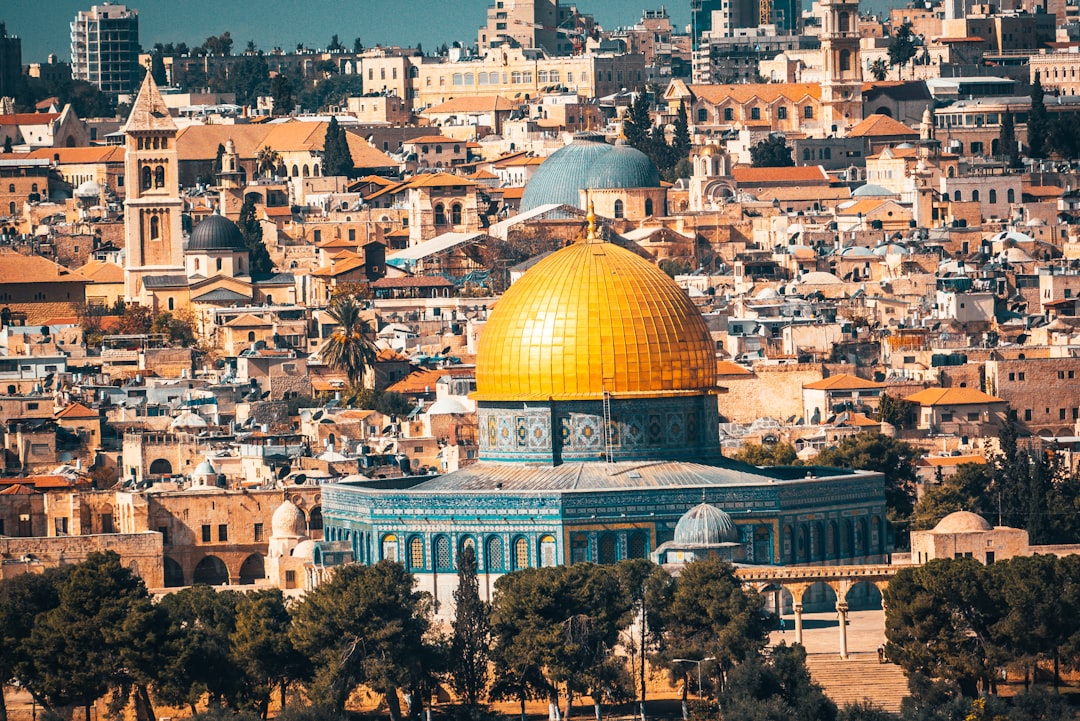
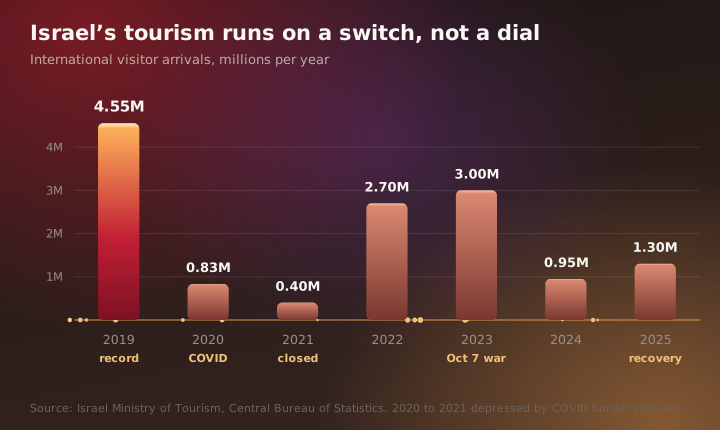
Israel's tourism does not fade the way most destinations do. It switches off, sometimes in a single night when the airspace closes, then switches back on almost as fast once the skies reopen. In 2019 Israel drew a record 4.55 million visitors. In 2024, the year after the October 7 war, it failed to crack one million. That is not a slow season. That is a light switch, and lately the hand on the switch has been the widening conflict between Israel, Iran, and the Gulf. Noovo is built around the three questions a destination like this forces at once, who you would go with, where, and when the window actually opens.
The booms and busts are the pattern, not the exception
Look at the last 25 years and the sawtooth is unmistakable. The Second Intifada in the early 2000s wiped out roughly a third of Israel's tourists. The COVID border closures took arrivals from 4.55 million in 2019 to a few hundred thousand in 2021, when the country was effectively sealed. Reopening in January 2022 brought a fast rebound to 2.7 million, and 2023 was trending back toward the record, around three million and climbing, right up until October.
Then October 7 happened, and tourism fell close to 80 percent almost overnight, with an 80 percent drop in flights and a near-total halt to incoming visitors, according to The Jerusalem Post. What matters is not just the size of each drop but the shape. Israel's tourism curve is not a gentle wave. It is a series of cliffs and rebounds, and the thing that pushes it off the cliff is almost never demand. People still want to see Jerusalem, float in the Dead Sea, and spend a weekend in Tel Aviv. What changes is whether it is safe to fly in, and whether their own government tells them to stay home.
The Gulf is now the variable that flips the switch
For most of Israel's history, the security shock was local, the West Bank, Gaza, the Lebanese border. The newest variable sits farther east. In June 2025, a 12-day war between Israel and Iran, capped by United States strikes on Iranian nuclear sites, did something a Gaza operation rarely does. It closed the sky.
Israel shut its airspace and grounded all flights at Ben Gurion Airport. El Al evacuated its fleet, Air France KLM, Ryanair, and Wizz Air suspended service, and Delta pulled its Tel Aviv flights through the end of August. The Tourism Ministry had to launch an operation to help roughly 38,000 stranded foreign nationals leave the country, as Haaretz reported. The airport reopened within days once a ceasefire held, and Ben Gurion returned to full operation. Off, then on.
Here is the part that surprises people. The disruption is regional, not just Israeli. Gulf airspace is one of the busiest aviation corridors on earth, and when it becomes a risk zone, the cost radiates outward. Airlines flying Europe to Asia reroute around it, adding fuel and hours. Analysts at Euronews put the Middle East travel industry's losses during the conflict at around 515 million euros a day. The Gulf hubs themselves, Dubai, Doha, and Abu Dhabi, kept their airports running throughout, but with sharply raised security. When the corridor that connects the region wobbles, Israel, sitting at its western edge, feels it first and hardest.
2026 shows the whipsaw in real time
The clearest picture of how fast this all moves is the current year. Israel opened 2026 strong. January brought 120,000 arrivals, up more than 52 percent year over year. February held at 113,300, up a third. Then March collapsed to 11,400. April came back to 35,800, and May nearly doubled that to 64,400.
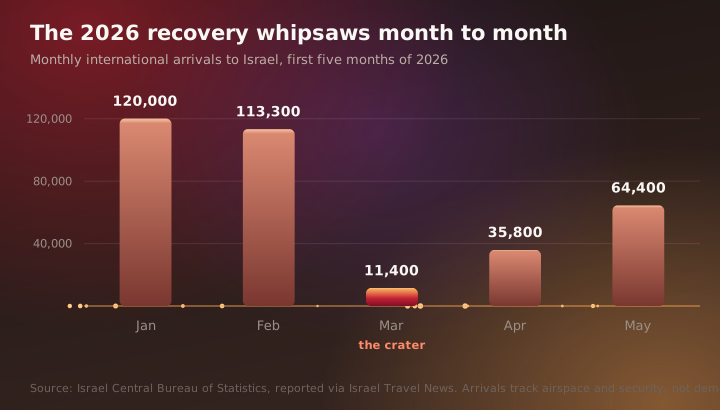
No normal tourism market moves like that. A ski town does not lose 90 percent of its visitors in a month and win most of them back the next. Israel does, because the number is not really measuring how many people want to come. It is measuring how many were able to. Across January to May the total landed at 344,900, down about 37 percent from the same stretch of 2025, per reporting on the Central Bureau of Statistics figures. And yet by June, arrivals from the United States and Canada alone were up 73 percent year over year. Down 37 in aggregate, up 73 in the segment that leads the recovery. Both are true. That is the whipsaw.
Who keeps coming, and why it matters
One group barely flinched. American travelers have led Israel's inbound tourism for six straight months, holding a commanding 35 percent share of all arrivals, and the United States remains the single largest source market at roughly 400,000 visitors in 2025, ahead of France near 159,000 and the United Kingdom near 95,000, as Forbes noted.
That concentration tells you who travels through uncertainty and who waits it out. Faith travelers, family visitors, and people with a personal reason to be there book first and cancel last. The leisure tourist who was choosing between Israel and Greece is the one who quietly picks Greece for a year. This is why the recovery always starts narrow and widens slowly. The committed return the moment the airport reopens, and the casual visitor follows only once a stretch of calm convinces them the switch will stay on.
The Gulf unrest cuts both ways
It is easy to read all of this as one direction, instability drives tourism down. The fuller story is that the same regional politics can push it up. The 2020 Abraham Accords, which normalized relations between Israel and the United Arab Emirates and Bahrain, opened direct Tel Aviv to Dubai flights and a two-way tourist flow that simply did not exist before. Gulf money, Gulf visitors, and Gulf connectivity became part of Israel's tourism map for the first time.
So the Gulf is not only the source of the shock. It is also, in calmer years, one of the growth stories. That is the real tension in the phrase political unrest in the Gulf. The same corridor that can close Israel's sky in a night is the one that, when it is open and normalized, feeds it. Which state the region is in on any given month is exactly what the arrivals chart is drawing.
What this means if you actually want to go
If you are thinking about a trip, the practical takeaway is not to wait until it is over, because there is rarely a clean over. It is to learn to read the window. As of 2026, Ben Gurion is operating and flights from the United States and Europe are running, while the United States State Department sits at a Level 3 Reconsider Travel advisory, with Gaza and the immediate northern border at Level 4. Inside the country, day-to-day safety is high and crime is low. The risk is not your afternoon in Jerusalem. The risk is that the airspace closes around your dates and reshuffles your flights.
That turns an Israel trip into a timing-and-people problem more than a destination problem. The place has been worth visiting for three thousand years and will be next year too. The open questions are the two Noovo is built around, when does a window actually open, and who would you go with when it does. A destination that switches on and off rewards travelers who can move on a good stretch of calm, together, rather than booking a fixed date a year out and hoping the region cooperates. If you have people who want to see this part of the world, the move is to know the moment the light turns green, and to already know who is free to take it. That is the same logic behind reading a destination in flux before you commit, and behind traveling safer without traveling smaller.
Israel's tourism will keep doing what it has always done. It will fall off a cliff, and it will climb back faster than anyone expects. The travelers who see it well are the ones watching the switch, not the calendar.
Sources
- Forbes, With 1.3 Million Visitors, Tourism To Israel Began Recovery In 2025
- The Jerusalem Post, Israel tourism struggles after Gaza war with worst crisis since 1948
- Haaretz, Israel to help foreign nationals leave the country after airspace closes
- Euronews, Iran war risks 40 billion dollar loss in Middle East visitor spending
- The Times of Israel, Record 4.9 million people visited Israel in 2019