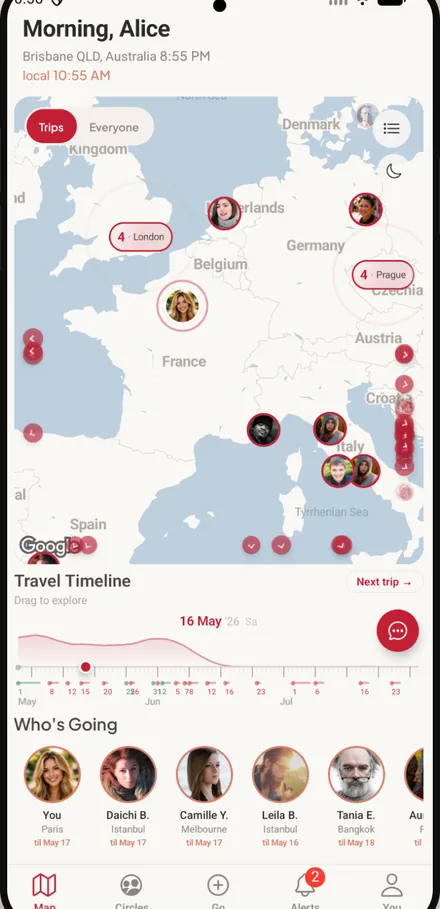

Travel risk is real, and badly distributed. Most of what goes wrong on a trip is small, fixable, and predictable. Noovo's job, as a social trip-planning app for friends, is mostly to handle one slice of that: making sure the right people know where you are without telling the entire internet. The rest of this article is the broader checklist I keep for myself.
Per a 2025 industry analysis on tourism scams, roughly 20% of international travellers report being scammed in some form on a trip. Nearly all of those scams are recoverable inconveniences, not catastrophes. The point of a safety practice isn't to eliminate risk. It's to keep it from ruining the trip.
The paperwork rules that actually matter
- The six-month passport rule. Many countries require your passport to be valid for at least six months past your return date. If you're flying inside that window, airlines often refuse to board you, and the government desk at arrival can deny entry. Check the expiry the day you book, not the day you pack.
- REAL ID, for US domestic flights. Per the TSA enforcement timeline, REAL ID has been required at TSA checkpoints since May 7, 2025. A standard driver's license without the star icon will not get you through a US airport. A passport works as a backup.
- Photograph your documents. Passport, driver's license, vaccination cards if you carry them. Store the photos in a place you can reach without your phone (an email to yourself works). The 90 minutes you spend doing this saves entire days if something is lost.
The cities where scams cluster
Some cities have an unusually high concentration of well-rehearsed tourist scams. CNBC's 2025 survey of nine global cities found Jakarta tops the list with 66% of tourists reporting at least one scam attempt, followed by Bangkok at 48% and London at 34%. Taxi overcharging is the most common pattern across all three.
Practical defences:
- Use the local ride-hailing app, not the street-flag. Grab in Southeast Asia, Bolt or Uber in most of Europe, Didi in China. The price is fixed before you get in.
- Book accommodations directly when you can. Per a 2025 study of US-targeted travel scams, roughly 1 in 5 vacation booking attempts hit a fraudulent listing, and 13% of victims lost over $500. Booking direct on a hotel's own site or through a major OTA reduces the surface area.
- Carry a working SIM or eSIM. The same study notes that travellers without mobile data are about three times more likely to be successfully scammed, because the friction of looking up a real address or calling a real number stops the con cold.
Solo travel safety, without the doomscrolling
Solo travel is at an all-time high. Per Riskline's 2025 solo female travel report, search interest for solo female travel is up roughly 5x compared to pre-pandemic levels, and 70% of women travellers say they think about safety more than they did two years ago. Higher awareness, mostly proportional to higher participation.
The habits that actually move risk:
- Share your itinerary with two people, not the internet. One at home, one nearby if you have someone.
- Pick accommodations with 24-hour front desk staff for the first night in a new country. The cost difference is small. The information difference is large.
- Have a "graceful exit" sentence ready for situations you want to leave. Practice it once before you need it.
Who should know you're travelling, and who shouldn't
This is the slice Noovo is built for. The case for sharing travel plans is real: friends nearby can meet up, friends back home can check in, and a known itinerary is what makes a missing-person search start in hours instead of days. The case against is that the wider the share, the more it leaks toward people who shouldn't know you're away from home.
Noovo's four visibility modes are designed for exactly this calibration. You can share a trip with all your followers (broad), a specific crew (your travel friends, your family), everyone except a specific crew (the surprise trip), or keep it fully private. Pick per trip. Change later. Nothing leaks beyond what you set.
The travel safety habits that aren't worth the energy
Some of the most common advice does very little:
- Hiding cash in three different places. Useful in 1995. Today, a working card and a working phone do more.
- Avoiding entire countries based on a single headline. National-level alerts rarely match the actual risk in a specific city or neighbourhood. Read the granular reports.
- Calling your bank before international travel. Most banks now use card-on-file geolocation and don't need the call. If yours still does, switch banks.
Travel safely. Travel often. The two are not in tension.