
Loneliness is climbing and so is travel with other people, and the two lines are not moving independently. The World Health Organization now counts one in six people worldwide as lonely, with the highest rates among people under 30. In the same years, the share of people who say travel is the best place to meet someone new jumped 15 points in a single year, and three quarters of Gen Z say they have gone abroad, or thought about it, specifically to meet people. At Noovo we plan trips around who you are going with, so we read those two curves as one story. People are not travelling in groups despite being lonely. They are travelling in groups because they are.
Turns out the loneliest generation is also the one most likely to book a flight to meet someone.
Loneliness is now a public health number, not a mood
In June 2025 the WHO Commission on Social Connection published its first global report and put a figure on it: about one in six people worldwide is affected by loneliness, and it is linked to an estimated 871,000 deaths a year, roughly 100 every hour. Among people aged 13 to 29 the rate is 17 to 21 percent, the highest of any age band. Lonely people are twice as likely to become depressed, and the report ties loneliness to higher rates of stroke, heart disease, diabetes and cognitive decline.
The number holds up across methods. Gallup asked adults in 142 countries whether they felt lonely "a lot of the day yesterday" and 23 percent said yes. Unmarried people came in at 28 percent against 19 percent for those with a partner. In the United States, Cigna's 2025 survey of 7,500 adults classified 57 percent as lonely, with Gen Z at 67 percent and Millennials at 65 percent, well ahead of Boomers at 44 percent. In England, the government's own Community and Engagement Survey for 2025/26 found 9 percent of 16 to 24 year olds feel lonely often or always, more than double the rate for people over 65.
Two years earlier the US Surgeon General had already declared loneliness an epidemic and compared the mortality impact of social disconnection to smoking up to 15 cigarettes a day. That line got quoted everywhere. The part that matters more for this article is what the same body of research says about the fix: time spent in person, doing things together, with people you can count on.
Close friendships have been thinning for thirty years
The lonely number is a symptom. The cause sits underneath it, in how many people we actually have.
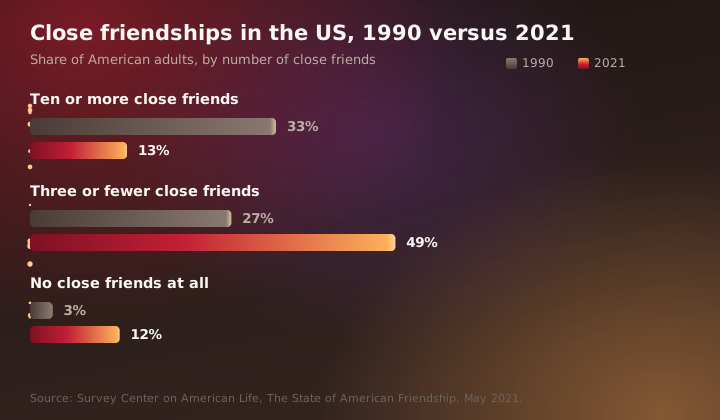
The Survey Center on American Life compared 1990 with 2021 and found that the share of Americans with ten or more close friends dropped from 33 percent to 13 percent. The share with no close friends at all went from 3 percent to 12 percent. Half of adults now have three close friends or fewer, up from 27 percent. Men fell hardest: the share with at least six close friends halved, from 55 percent to 27 percent.
This is not just an American story. A cross-temporal meta-analysis covering 1976 to 2019 found loneliness among 18 to 29 year olds rose by more than half a standard deviation over that period, while it barely moved for older adults. WeRoad's 2026 survey of 5,000 people across Italy, Spain, France, Germany and the UK found 66 percent say meeting new people is harder than it used to be, up 8 points on the year before, and 52 percent are dissatisfied with their social relationships. The most common reason given was not shyness. It was a lack of opportunities in everyday life, cited by 47 percent.
That last number is the hinge. Everyday life stopped producing the situations where friendships form, so people started looking for those situations somewhere else.
The loneliest generations are the ones booking trips to meet people
Here is where the curves cross. Ask who is loneliest and you get Gen Z and Millennials. Ask who is travelling specifically to find people, and you get the same answer.
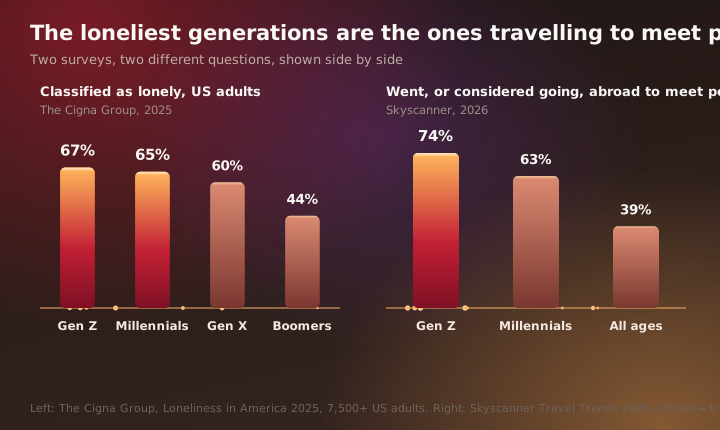
Skyscanner surveyed more than 20,000 people for its 2026 Travel Trends report. 39 percent said they had gone, or considered going, overseas specifically to meet new people, for friendship or something more. Among Gen Z that figure was 74 percent, and among Millennials 63 percent. Use of the "solo traveller" hotel filter rose 83 percent year on year, and a large share of those bookings are people heading somewhere to join others, not to be alone.
WeRoad's data moved the same way, and faster. In 2025, 30 percent of respondents named travel as the best place to meet people. In 2026 it was 45 percent. 72 percent said they want more offline social experiences and 63 percent want to belong to a group built around a shared interest. Hilton's 2026 Trends Report, a 14,000-person survey across 14 countries, found Gen Z (26 percent) and Millennials (24 percent) are the generations most likely to travel with friends, and a third plan a group trip in 2026 around a shared passion, from music to running.
Read those together and the relationship sharpens into something more useful. At the population level, loneliness and group travel rise together, because one is the demand signal for the other. At the individual level they run in opposite directions. The more of your travel happens with other people, the less lonely you report being. That second claim is the one worth testing, so here is the evidence.
Travel measurably lowers loneliness, and the effect grows with distance
The cleanest data comes from a 2024 study in the International Journal of Environmental Research and Public Health, using the US Health and Retirement Study. Researchers Cole, Hua, Peng and Wang sorted 7,037 adults aged 51 and over into non-travellers, local travellers, domestic travellers and international travellers, then compared loneliness, depression and cognitive function.
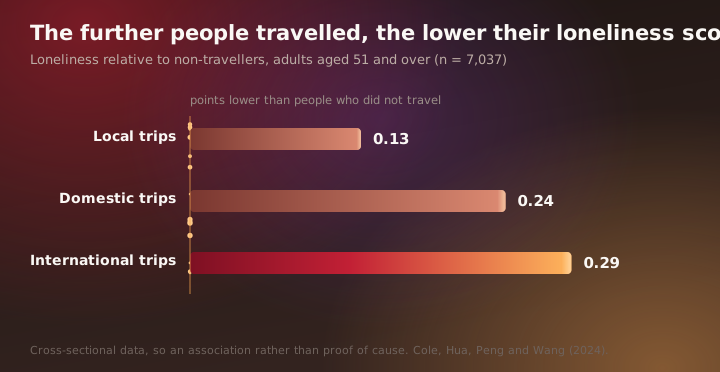
Every travel group scored lower on loneliness than people who stayed home, and the gap widened with distance: 0.13 points for local trips, 0.24 for domestic, 0.29 for international, all significant at p < 0.001. Depression symptoms fell by 0.36, 0.81 and 0.94 on the same ladder. The authors are careful to call it an association, since the data is a snapshot rather than an experiment, and the study measured travel of any kind rather than group travel specifically. But a clean dose-response pattern across three outcomes is not noise, and the mechanism they propose is the obvious one: travel creates concentrated time with people, and concentrated time is where connection happens.
The industry's own numbers point the same way, with the usual caveat that companies measure their own customers. WeRoad found 66 percent of people who travelled in a group built a meaningful connection with someone they met on the trip, and 83 percent say they are more open to others while travelling. Flash Pack, which runs small-group trips for people in their 30s and 40s, reports that 80 percent of its travellers stay in touch after the trip ends. Self-reported and unaudited, but consistent with the peer-reviewed pattern above.
Why a trip does what a group chat cannot
Ask people what turned a stranger into a friend on a trip and the answers are about time, not activities. In WeRoad's survey, 60 percent credited shared experiences, 43 percent credited spending entire days together, and 30 percent credited being away from routine. Half said the relationships they form while travelling feel more genuine than the ones at home, and the reasons given were the absence of expectations and not being stuck in their usual role.
That maps onto what friendship research has said for decades. Close friendship needs three things in the same place: repeated unplanned contact, proximity, and a setting where people drop their guard. University delivered all three by accident. Adult life delivers none of them by default, which is why 47 percent of WeRoad's respondents blame a lack of opportunities rather than any failure of nerve. A trip rebuilds the conditions in a week. You wake up in the same place, eat at the same table, get lost together, and by the third day the small talk has run out and the real conversation starts.
The group chat, by contrast, is where trips go to die. The intention is real and the people are real, but the chat has no dates, no destination, and no moment where anyone has to commit. It produces the feeling of planning without the trip.
The people you already know are the easiest group to start with
Most of the coverage on travel and loneliness points at organised group tours, and they work for many people. But the pattern above does not require strangers. It requires a set of people, a place, and a block of days you all spend together. The friends you already have are the shortest path to that, and the reason it rarely happens is coordination, not desire.
In WeRoad's US focus group, seven in ten had simply given up on travelling unless someone came with them. Not because nobody would, but because nobody knew when anyone else was free. That is the whole gap. The person exists, the intent exists, the window exists, and none of the three are visible to each other.
This is the problem Noovo is built around. You start with whichever piece you have. A friend you want to travel with, a place you cannot stop thinking about, or a week that just opened up. Then you see who else is free in that window, where your people are already headed, and where the overlaps are. The trip stops being a message that nobody answers and becomes a set of dates that three of you already share. If you want the mechanics, start with how to plan a trip when the person matters most or how to find out which friends are free to travel. If you are travelling solo and want company on the ground, solo, but not alone covers the overlap approach.
The loneliness numbers are not going to fix themselves, and no app fixes them either. What fixes them is a week somewhere with people you like, and enough visibility to make that week happen more than once a year. Find the overlap. Pick the place. Go.
Sources
- World Health Organization, Commission on Social Connection report, 30 June 2025
- Gallup, Over 1 in 5 People Worldwide Feel Lonely a Lot, 2024
- Survey Center on American Life, The State of American Friendship, 2021
- The Cigna Group, Loneliness in America 2025
- US Surgeon General, Our Epidemic of Loneliness and Isolation, 2023
- Cole, Hua, Peng and Wang, Exploring the Relationship of Leisure Travel with Loneliness, Depression, and Cognitive Function in Older Adults, International Journal of Environmental Research and Public Health, 2024
- Skyscanner, Travel Trends 2026
- WeRoad Research 2026, loneliness and making friends as an adult
- Hilton, 2026 Trends Report